Friday, 24 September 2010

Rs50 bn loans written off

Pakistani banks have yet again quietly written off Rs50 billion fresh loans outstanding against their borrowers during the last two years and at the same time, Pakistan’s total borrowing from World Bank (WB), Asian Development Bank (ADB) and International Monetary Fund (IMF) reached to $31billion.It has been revealed that Islamabad was now paying $3.6 billion interest alone each year on these foreign loans. Finance Minister Dr Abdul Hafeez Sheikh shared the mind-boggling figure of loan written off by the Pakistani banks in the National Assembly during the question hour. In the same session, Minister of State for Economic Affairs Division Hina Rabbani Khar, however, made revelations about the total foreign loans of three lending agencies followed by annual payment of interest by the Government of Pakistan.
These two figures about the loans — one written off and other obtained from the international lending agencies — were presented in the National Assembly during the question hour by Hina Rabbani Khar.These facts tell a sorry state of affairs as how on the one hand the country was massively borrowing from the international institutions to meet its own financial gaps and on the other how their own banks were busy in writing off the massive amounts running into billions.
The Supreme Court is also seized with loan write off case of 2007 when it was reported in the media on the basis of Auditor General’s report that Pakistani banks had written off Rs60 billion. Chief Justice Iftikhar Muhammad Chaudhry had taken a suo moto notice of this story. The Supreme Court is yet to take any decision on this case since 2007 and banks continued to write off loans. One official said, “we had to differentiate between the genuine written off loans and those who were using their clouts to get those principal and marks up written off every year.”Meanwhile, in a reply to a question by Sheikh Salahuddin, the finance minister said a sum of Rs50.854 billion was written off by the banks during the last two years. Replying to another question of MNA Raja Asad, Hina Rabbani revealed that the country had borrowed $31billion till June 30, 2010 from WB, ADB and IMF and was paying $3.6 billion as interest each year. Giving the break up of loans, she said world had given $11.4 billion loan and was being paid $1.6 billion every year as interest on these loans. Pakistan took $11.58 billion from ADB and was paying $1.4 billion as interest on annual basis. $8billion have been borrowed from IMF and $445 million per year are being paid to them as interest.

Thursday, 16 September 2010

225 suicides in a month

At least 225 people including 73 women committed suicide during the run of last one month.
According to Pakistan Commission for Human Rights, the most of people put an end to their lives under juggernaut of poverty and hostile circumstances. The report said at least 351 incidents of suicides and suicide attempts were reported during last one month; however, only 39 FIRs were registered against these incidents.
According to the report, at least 18 people were killed in the name of honour in Sindh, of them, Ghtoki’s eight year old Dadan is also included. The report said at least 27 people including 21 women were sexually maltreated across the country; of them, Matli’s four-year-old and Tando Muhammed Khan’s five-year girl are also included.
According to experts, the hike in suicidal incidents in the country is an alarming phenomenon thanks to the rampant non-tolerance in the society.

Thursday, 2 September 2010

Discrimination in Aid Distribution

It is no secret that ethnic, sectarian and religious minorities in Pakistan face discrimination, but recent reports that this deplorable mindset is affecting flood relief efforts are deeply disturbing. On Monday, a large number of people in Hyderabad were driven to taking out a protest rally against the maltreatment of minority community flood victims. They cited two occasions when they were attacked and driven out of a relief camp.

A day before that, flood-affected families at an emergency relief camp in Thatta district complained that they were being refused aid, even by government officials, because they were Dalits. There have been numerous other reports: people being refused shelter because of their ethnicity, caste or religion, being discriminated against in the distribution of aid goods and being driven away from or forced to live on the very margins of the few camps that exist.

Discrimination on ethnic and religious grounds is deeply entrenched in Pakistan and will not change overnight. Yet that it is being used as an excuse to strip people of their rights as equal citizens even during a time of calamity is abhorrent. Whether Muslim, Hindu or Christian, high caste or low caste, the flood victims are all equally deserving of the attention of official and non-official aid channels. Resources are scarce and the desperate number in millions. Providing help across the board to the best of its abilities, irrespective of any ideology, is the first task of the state and society. Apart from the victims’ equal right to survival essentials such as shelter, potable water and food, the fact that the country was even before the floods rent along ethnic, sectarian and religious grounds must be kept in mind. Discrimination at this time will only deepen the divide and cause resentment that could unravel any possibility of future cohesiveness.

Wednesday, 25 August 2010

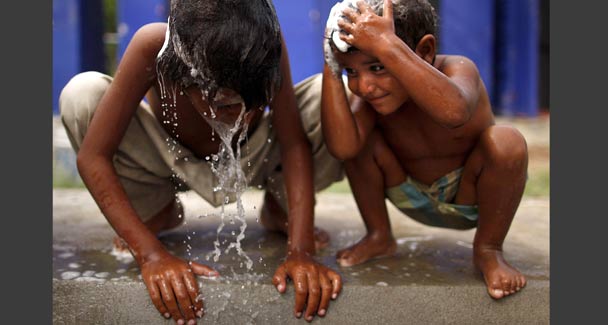
"Innocent Faces" from the flood

Images of children at flood relief camps from across Pakistan, as water ravages the country and renders millions homeless.


Thursday, 17 June 2010

Serious Problems - Who cares

Coverage of the provincial budget announced by Khyber-Pakhtunkhwa Finance Minister Humayun Khan on Saturday has been dominated by the theme of ‘balanced budget’: Rs294bn of expenditure matched by Rs294bn of revenue. At first blush, this may seem to be a good thing. But scratch below the surface and serious problems become apparent. First, the province’s revenue projection relies heavily on money flowing from the centre as promised — a pledge that is already looking shaky. For example, if the Rs25bn in hydel power profit arrears is not forthcoming, a serious hole will appear in Khyber Pakhtunkhwa’s finances. The sum is part of Rs110bn that was awarded to it in an arbitration with the centre and is to be released to the province over four years. Yet, privately provincial officials are pessimistic that the arrears will be released, pointing to the fact that the province has only been allocated Rs6bn as hydel generation profits for the next fiscal year — several times lower than what they believe is owed.
Next, on the expenditure side of things, while the NFC award last year has increased transfers to the province and therefore improved the fiscal space, a majority of the money is to be spent on salaries, and a great many of those salaries are paid to employees who are not needed. It seems that in a war-torn, recession-hit economy, provincial administrators have struck upon a favourite ploy to appease voters: giving them jobs in government agencies. At least three new government departments have been created rather than trying to encourage job creation in the private sector.
The main challenge, then, for the government going forward will be to mobilise its own resources. Relying on uncertain federal receipts and making unnecessary provincial expenditures will only destabilise its finances. For example, the Rs21bn allocated to the police has more than doubled the present year’s outlay — arguably a necessary step — but the centre cannot be relied on to keep footing the bill. To be sure, Khyber Pakhtunkhwa has suffered disproportionately over the last years from militancy; however, that should not be used as an excuse to further delay reform.

Missing Persons Case

The reassurance given by the chief justice at a meeting of the National Judicial Policymaking Committee in Quetta on Friday with regard to efforts to find the ‘missing’ persons should give some hope to the affected families. The apex court has been seized of the matter for five years now but the current government, like the previous one, has done little to recover the missing, a large number of whom belong to Balochistan where Gen Musharraf launched an operation to rein in Baloch nationalists.
The families of those gone missing have alleged that their dear ones were picked up by intelligence agencies on suspicion of involvement in terrorist activities, and that some may have been extradited to interrogation camps on foreign shores. That is why, unfortunately, the term ‘missing’ is often used as a euphemism for those presumably picked up by intelligence agencies and kept in illegal confinement without being arraigned in a court of law with charges brought against them for trial under due process. The number of such people is said to be in the hundreds. Few have been located or recovered so far.
The recently formed judicial commission to probe the phenomenon and help locate the whereabouts, or indeed fate, of those gone missing is a step in the right direction. Yet, the commission alone cannot ensure their recovery as there is hardly anything by way of official record concerning those held in illegal custody or prosecuted without due process. It is a particularly sensitive issue in Balochistan given the province’s many genuine grievances against the modus operandi of a highhanded federal and military intelligence and security apparatus. For democracy to take root it is crucial for the missing persons to be located and administered justice and for their tormentors to be held to account for violating the law.

NWA Operation

Pakistan is buying time in North Waziristan - gathering intelligence, building alliances and insisting any assault into the Taliban and Al-Qaeda fortress take place at its own time and choosing.
Part of the tribal belt on the Afghan border, North Waziristan is home to 350,000 people but considered a stronghold for the most dangerous militants in the world and largely impenetrable.
It is also a rumoured hiding place of Osama bin Laden.
Commanders are walking a tightrope, balancing US pressure for action against fears that a major push into the hornet's nest would make enemies they cannot beat and drag Pakistan into a new wave of violence.
As well as the bin Laden connection, North Waziristan's mountains are also a refuge for Pakistani Tehreek-e-Taliban who escaped an offensive in neighbouring South Waziristan and networks fighting US forces in Afghanistan.
Among those using bases in North Waziristan are the Haqqani network, created by Afghan warlord Jalaluddin Haqqani and run by his son Sirajuddin; Afghan Taliban; Pakistani warlord Hafiz Gul Bahadur and his ally Maulvi Sadiq Noor.
They are blamed by the United States for fuelling the nearly nine-year insurgency in Afghanistan, for attacking the 142,000 US-led Nato troops there and for working to destabilise the Western-backed government in Kabul.
But they are also men whom the Pakistani security establishment believes pose no direct risk to the homeland because their activities are targeted across the border, while homegrown Taliban pose a more immediate threat.
Opening a new front against the likes of Haqqani and Gul Bahadur would, Pakistani officials believe, make enemies out of well-trained, well-financed groups that are potentially valuable allies when US troops leave Afghanistan.
Given the risks involved and strain on Pakistani troops, with forces actively engaged in six of the seven tribal districts, analysts say fears of a backlash, including attacks on civilians, are holding the army back.
Last year saw a huge surge in attacks in retaliation for military offensives in Swat and South Waziristan, followed this year by a relative decline.
Around 140,000 troops are deployed along the western border, leaving 100,000 in the east, where Pakistan meets India, and commanders are wary of leaving that frontier more exposed.